
National Science Week - A/Prof Anne Brüstle
For National Science Week (August 15th – 23rd), Women’s Global Health Australia is proud to launch another special profiling series to highlight the incredible work of women in science and health research.
Secretariat member Alice McCann spoke with Associate Professor Anne Bruestle who shared her science journey, combatting autoimmune conditions including multiple sclerosis. She provides incredible insight into the world of science and leadership for women.
Please introduce yourself and tell us a bit about what you currently do
My name is Anne Bruestle, I am Associate Professor at the John Curtin School of Medical Research at the ANU and lead the Neuroimmunology and Multiple Sclerosis Group. I was also recently appointed to be the Associate Dean Inclusion Diversity Equity and Access (IDEA) at the College of Science and Medicine.
My research looks at how the immune system contributes to MS, and how we can use this knowledge to better understand, monitor and ultimately treat this neuroinflammatory condition. A major focus of my work is on the innate immune system, which has traditionally received less attention in MS than the adaptive immune system.
What I particularly enjoy is working across different areas of research. My work spans from experimental models and fundamental immunology through to studies involving people living with MS.
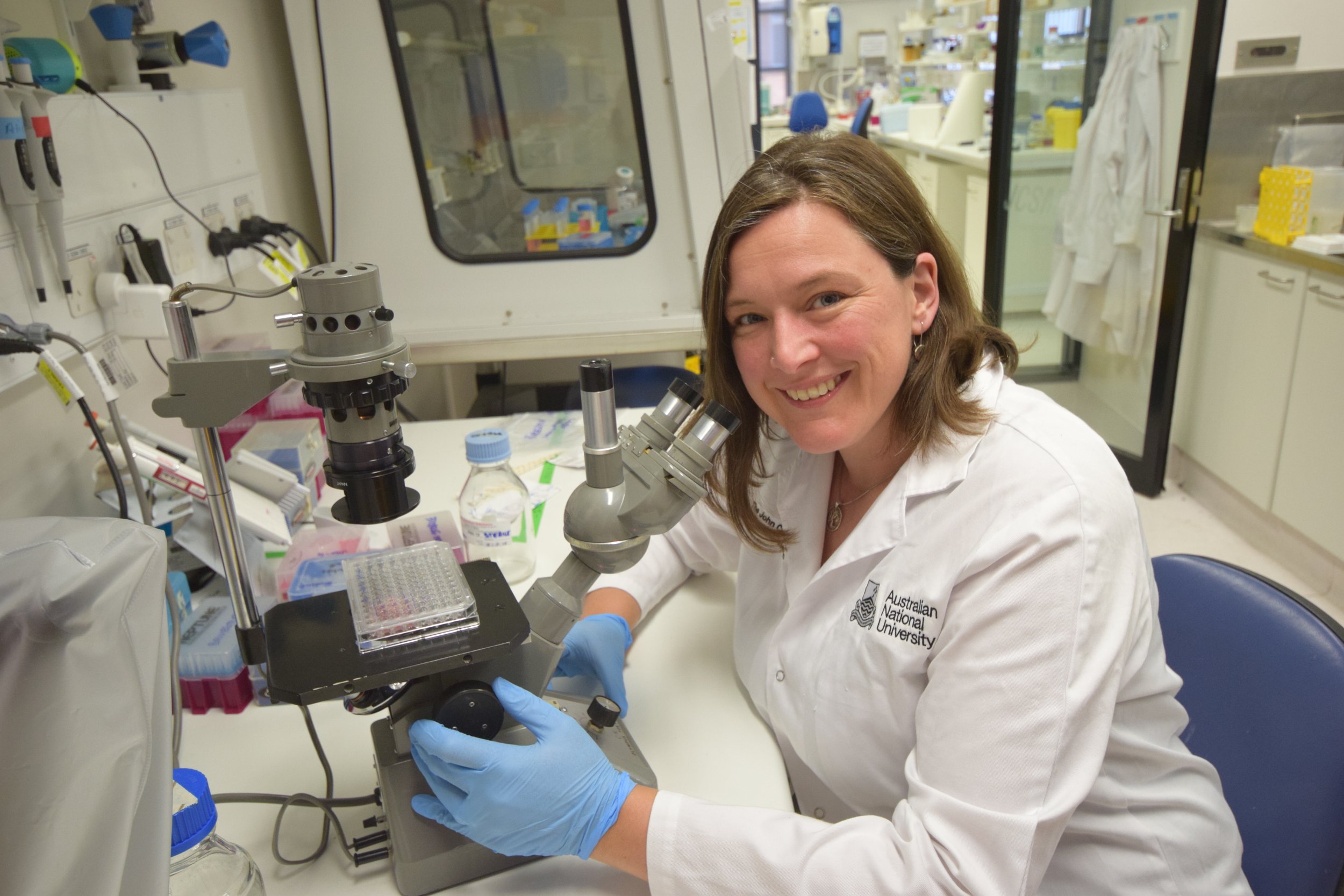
In the Lab! Looking at cells under the microscope
You have a wealth of experience in health sciences; tell us a bit about how you got to where you are today.
My career has probably been less of a straight line and more of an evolution. I have always been fascinated by immunology and by the complexity of the immune system – particularly the fact that the same system that protects us can also contribute to disease.
After a PhD in human biology from the Philipp University in Marburg, Germany, where I studied on fundamental aspects of immune cells, I went to Toronto in Canada to do postdoctoral research. I was exposed to diverse models of autoimmunity but, still, I was only working in models and model systems rather than the lived experience. While this was super exciting and interesting, I often wondered how my work would translate to people living with these conditions. When I moved to Canberra for my first independent position I searched for possibilities to bring my work closer to translation. In fact, despite having worked for over a decade in models related to MS I had at this point never had a conversation with a person living with it. That needed to change. With the help of my mentor Professor Robyn Lucas, I initiated the Annual Canberra MS Symposium inviting the local MS community to come to the John Curtin, hear about the current research and share their experiences. I also funded the John Curtin FishNETs a team of researchers and their families to raise funds for MS.
From there, I have moved towards multidisciplinary and translational research. Modern health research cannot really happen in isolation. I now work with people with very different expertise, and I think some of the most interesting ideas emerge when you bring those different perspectives together.
What does National Science Week mean for you? What does leadership in science look like to you?
For me, Science Week is an opportunity to celebrate science, but perhaps more importantly, to make science accessible.
I also think it is an opportunity to inspire curiosity and being curious is the first step of becoming a scientist.
For me, leadership in science is not about being the loudest person in the room or having all the answers. It is about creating an environment where people feel comfortable contributing ideas, asking questions and challenging each other.
Good science is collaborative, and good leadership should enable that collaboration. It means recognising that different people bring different strengths and perspectives, giving people opportunities to develop, and being prepared to listen and change your mind.
I also think leadership comes with a responsibility to create opportunities for the people coming after us. Science can be highly competitive, but we do better science when we support people rather than simply competing with them. A successful research group, to me, is one in which everyone has the opportunity to grow.
The same applies to my role as Associate Dean IDEA. I see it as my primary task to foster a culture where everyone feels valued, respected, and empowered to succeed.
What is your favourite thing about what you do?
I think I have two:
First, the discovery. I still really enjoy the moment when you look at a set of data and realise that your hypothesis was correct or that you are seeing something unexpected that has you change the way you think about the question asked.
Second, the impact of my work. For me this is not measured in papers and funds received but in seeing a PhD student evolve into independence or hearing form a person living with MS: “Thank you for giving us hope”
What challenges have you faced in your career, and how have you overcome them?
Science is an incredibly rewarding career, but it is highly competitive and demands a lot. I am not the brilliant, focused alpha type like many of my successful colleagues. Throughout my career I encountered many people (other scientists, teachers, superiors) who told me that my “extracurricular activities” distract from my research and career progression and that if I don’t put more focus on the matter will not succeed. I strongly disagree, I think it is most important to be more than just a scientist and that the facets of our lives just make us more diverse and better-grounded people. This in return enables us to bring other perspectives back into our science.
Another thing I have learned is not to interpret every rejection as a judgement on the quality of science or on yourself as a scientist, or person. Particularly with grants and publications, excellent work can be rejected. You learn from feedback, improve what you can and try again.
I have also learned how important it is to have good people around you. Mentors, colleagues and collaborators who will give you honest advice, support you when things do not work, and celebrate the successes with you make an enormous difference. Resilience in science is important, but I don't think resilience has to mean doing everything on your own.
What do you believe are the most pressing issues or priorities for women in global health and research right now?
I think representation remains a major issue, and this is even worse for women from lower social economic background or women of colour. This is particularly striking as you move into senior leadership and decision-making positions. We have many talented women entering science and health research, but we still lose too many of them along the way.
Importantly, representation is not just about numbers. It is also about who gets the opportunity to lead, whose ideas are heard, who receives funding and recognition, and who is sitting at the table when priorities are set.
There is also a broader issue around whose health questions we choose to investigate. Historically, women have been underrepresented in many areas of medical research, and women's health issues have not always received the attention or investment they deserve. We need diversity both among the people doing the research and among the populations represented in that research. If we want health research to benefit everyone, the research itself needs to reflect everyone.
